
Over the past 48 hours, Comet 17P/Holmes has brightened from 17th magnitude (you'd need a good telescope) to 2nd! Not only is that visible with the naked eye (even in a city!), if it were a star it would make the "100 Brightest" list. Even seasoned observers are calling this the most amazing comet they've ever seen.
Nobody knows exactly why it's brightened so much, although a couple of ideas have been thrown around: Did it get smacked by an asteroid? Did the nucleus split in two? Was there a big cavern below the surface (that used to be full of ice, which evaporated and produced the comet's tail in the past) which collapsed? So far, various folks have various reasons to discount all of these explanations. In particular, the "smacked by an asteroid" explanation (baseball fans, see here) is unlikely, because this comet actually did something very similar when it was discovered in 1892, and at about the same point in its orbit.
If the similarities with 1892 are to be believed, the comet should stay bright for about 3 weeks, and probably develop a nice tail over that time. (It's gonna take time for the dust thrown up into the coma to stretch out behind the comet.) I hope that's the case, because from Anchorage we seem to get a clear night only every couple of weeks or so...
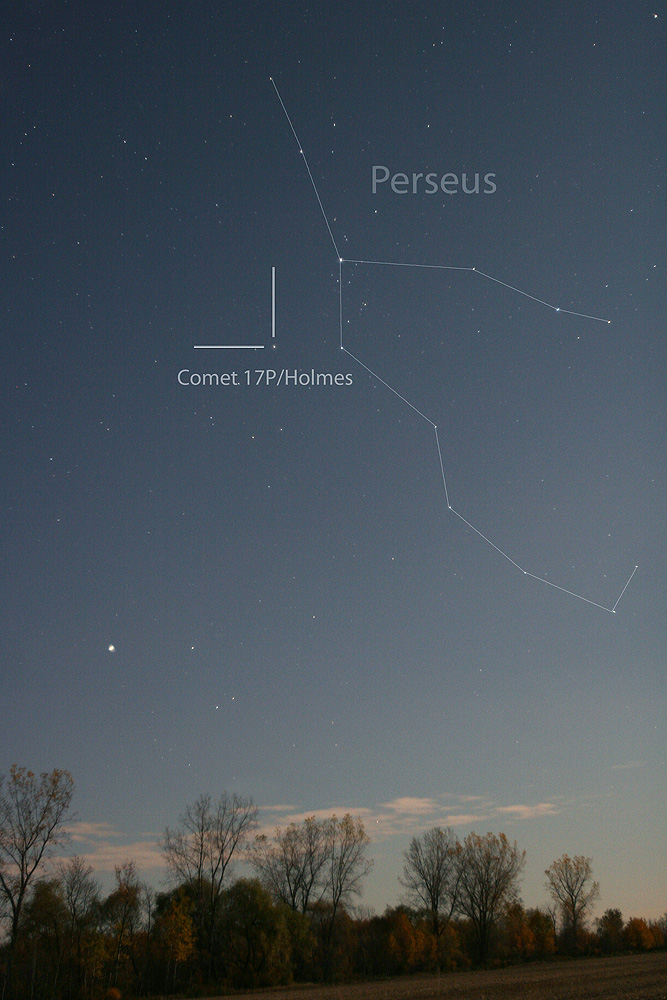
Get out and try to find this thing, and post comments if you find it! See below for finding charts. Tonight, I think your best bet is to look halfway between the Moon and the Big Dipper's bowl. It's also on a line between the Little Dipper and the Pleiades (7 Sisters). But you'll have to know what the constellation Perseus is supposed to look like, so you can tell where the "new star" is. I made the last two finder charts below myself with Starry Nigth. Both are for 8pm tonight (Oct 25th) from St Louis (where I figure most of our loyal readers live). In the last picture, I show you where the comet is heading over the next 3 weeks. (The format is "day-of-month:time".)
Happy Hunting!


1 comment:
This shows the brightening over time:
http://perso.orange.fr/fkometes/images/comets_img/holmes24-26.jpg
Post a Comment